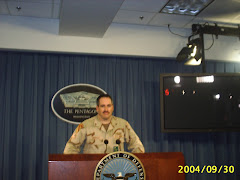
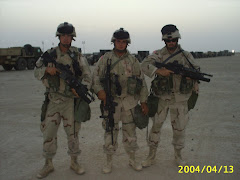
One of my constant worries or problems I deal with, is the constant pain that I am in. No matter what I take my back is always in pain, it just lessens the degree of pain, but never eliminates the pain. On my bad days I hobble around like an old man, on my good days I can walk about with some degree of pain. While training up for Iraq, at Ft Hood TX & Ft Irwin CA, I wrecked my back running around with all the gear on, Body armor with plates, ammo, grenades, camelback filled w/ water, kevlar helmet & other gear putting a tremendous strain on my back. When I got to Iraq, my back got worse, but I had to keep going. Kept aggravating the injuries. I'd have to hit the deck when shots were fired, jump back up, with the body armor plates digging into my back. When the Iraqi guard towers were taken fire I'd have to race up the steel ladderways to get to the towers. I was 42 running around with 20 year olds. As an Infantry Fire Team Leader, It was my responsibility to be first man up into the towers & put my head over the wall. Adrenaline kept me going, there was no taking it easy. Sleeping on a hard army cot, did not help it any either.
When I got medevac'd out of Iraq 29 Jan 05, from a heart attack, it was a hard thing to leave my team behind. I tried to get the doctor to send me back, but they medevac'd me to Landstuhl Germany. My back started to heal somewhat while at Landstuhl, they gave me percocet & flexiril to help deal with the pain & heat packs to help my back. When I got to Walter Reed, I played down the back injury because I was trying to get my cardiac doctor to sign off on me returning to my unit in Iraq. He stalled me off until it was too late for me to go back, then I started to actively try and get treatment for my back. I went thru pool therapy, physical therapy, accupuncture, chiropracter, tens unit, they would help some, but my back kept getting worse. I was told that I was not a good candidate for back surgery. The final conclusion was that I would just have to live with the pain for the rest of my life.
I went through the corrupt and inept Army Medical Evaluation Board (MEB)/ Physical Evaluation Board (PEB). I was evaluated by Dr Harvey Cohen, who is openly biased against National Guard & Reserve soldiers, he told me that "You are just another National Guard soldier trying to live off the government" Now if he had been biased against me for race, gender, or religion there would have been a problem but it was ok for him to be biased against me for being a National Guard soldier. The board final determination was unfit for duty 10% which means I was medically retired with 0 compensation. Going through the MEB/PEB is one of the most humiliating and degrading experiences I have ever been to. They treated me more like a common beggar looking for a handout. I wanted to be fixed, they could not heal me so I wrongfully expected the Army to do the right thing & fairly compensate me for my disabilities.
I tried to get politicians to do something about the Army MEB/PEB, but no help, they smile shake your habd take a picture with you, then you never hear from them again. I Brought it to the attention of President Bush, Senator Hillary Clinton (D-NY), Senator Edward Kennedy (D-MA) Senator Domenci (R-NM), Senator Snow (R-ME), numerous Congressmen & Senators during the Building 18 scandal, but to no avail. The Army was allowed to continue its humiliating and disgraceful treatment of combat veterans. There were many other veterans screwed over by the corrupt system. I will go into further detail in future posts. Dr Harvey Cohen is still doing his biased evaluations & screwing hundreds or thousand of Wounded Warriors, in the MEB/PEB. It goes on because he saves the Army millions of dollars at the Wounded Warriors expense.
So now I am going through the VA health care, where they seem to be trying to save money by not prescribing pain medications, and I must battle their evaluation system, right now it stands at 40% but I am sure it will increase in time. I have been out of work due to my various injuries & PTSD related problems. I just would like to get back to my normal self, if that is possible. I used to be outgoing, fun, life of the party, hard charger, now I am withdrawn, I stay at home, avoid friends & family.
Showing posts with label Army Medical Evaluation Board. Show all posts
Showing posts with label Army Medical Evaluation Board. Show all posts
Friday, July 24, 2009


Tuesday, May 26, 2009
Depression - as linked to Post Combat or PTSD
Many combat veterans have to deal with various forms of depression, when they return from a combat zone, especially those that get medevac'd out earlier from being wounded or injured, and leaving their comrades behind. Again I will start by using the Wikipedia definitions for various depression states, I did not find any relating to Post-Combat or PTSD, maybe in the future their will be when the Military Psychiatric Doctors & Medical Evaluation Boards start doing the right thing by our Combat Veterans. Also this Post-Combat or PTSD Depression is one of the major causes of so many suicides in our return War Veterans.
These are the various types of psychological depression, as defined in Wikipedia:
Major Depressive Disorder: (also known as clinical depression or major depression), a specific diagnosis from the Diagnostic and Statistical Manual of Mental Disorders by the American Psychiatric Association.
1) Major Depressive Episode
2) Atypical Depression, a cyclical sub-type of major depression where sleep, feeding and perception of pleasure are normal but there is a feeling of lethargy.
3) Melancholic Depression, a sub-type of major depression characterized by an inability to feel pleasure combined with physical agitation, insomnia, or decreased appetite.
4) Psychotic Depression, a sub-type of major depression combined with psychotic or delusional perceptions.
Depression (mood).
Postpartum depression, a depressive episode occurring within a year of childbirth.
Dysthymia, a long-term low-grade depressive condition.
Adjustment disorder with depressed mood, previously known as "reactive depression"
Seasonal Affective Disorder (SAD), a depressed mood related to the seasons.
Depression is the fourth stage of the Kubler-Ross Model (commonly known as the "stages of grief").
That was the Wikipedia definition & breakdown of varios forms of depression, like I said above, I believe eventually there will be another diagnosis, dealing with Post-Combat or PTSD(Post Traumatic Stress Disorder/TBI Traumatic Brain Injury. I myself have dealt with and still is fighting depression, and it has been over 4 years since I have been back from Iraq. When I was first medevac'd out of Iraq to Landstuhl Army Medical Center in Germany, I fought and argued with the doctors to go back to rejoin my unit, I had a deep feeling of guilt and felt ashamed because I was safe in Germany and they were still in harms way. I have talked to many other wounded and injured veterans at Landstuhl and at Walter Reed Army Medical Center, where I was sent after Germany, they all had felt the same way guilty and ashamed to leave their comrades behind. It is some that the Army Medical Centers do not deal with properly, which is why their are so many suicides in wounded and injured soldiers. When I first got to Walter Reed, there were two to three suicides a week, we kept hearing the ambulance in middle of night pulling up to the Molonge House where many of the outpatients were housed. It got better, but there are still a lot of suicides nationwide at Army hospitals. A member of my unit that got medevac'd out of Afghanistan, gunshot wounded to arm, was recovering well, committed suicide at Fort Bragg, while recovering. The Army needs to take a serious look at the Psychiatric Doctors & Practices, many of Army Psychiatrists are fresh out of school and inexperienced. Coupled with the Army thinking that most returning Veterans, are "faking it" especially National Guard and Reservists.
The Army Medical Evaluation Board(MEB)/Physical Examination Board(PEB), does everything possible to avoid documenting & compensation soldiers suffering from depression, PTSD & TBI, the evaluating psychiatrists will blame it on pre-existing conditions, like pi-polar disorder, anxiety & mood disorders, or just claim the soldier is just faking it or exagerating his or her condition. It is really a humiliating process for a combat veteran to go through. It is hard enough in the first place(with all the stigmatism attach to these conditions), to come forward and admit you have a problem, but to then go through this process and be treated like a dirtbag or someone who is faking it, is too hard for some soldiers to bear. This is part of the reason for so many suicides in returning combat veterans.
I feel that the entire Medical Evaluation Board (MEB)/ Physical Evaluation Board (PEB) system must be revamped, get rid of all the people currently on there, and get qualified, caring and profeessional people on the boards. The Army has to stop trying to save money by the blood of it's combat veterans, and take responsibility for doing the right thing. Fairly compensate these soldiers for there wounds, injuries and mental problems. Get them the proffessional help they need. And follow up on these soldiers, even when they are out of the system and make sure the Veterans Administration is taking proper care of them.
These are the various types of psychological depression, as defined in Wikipedia:
Major Depressive Disorder: (also known as clinical depression or major depression), a specific diagnosis from the Diagnostic and Statistical Manual of Mental Disorders by the American Psychiatric Association.
1) Major Depressive Episode
2) Atypical Depression, a cyclical sub-type of major depression where sleep, feeding and perception of pleasure are normal but there is a feeling of lethargy.
3) Melancholic Depression, a sub-type of major depression characterized by an inability to feel pleasure combined with physical agitation, insomnia, or decreased appetite.
4) Psychotic Depression, a sub-type of major depression combined with psychotic or delusional perceptions.
Depression (mood).
Postpartum depression, a depressive episode occurring within a year of childbirth.
Dysthymia, a long-term low-grade depressive condition.
Adjustment disorder with depressed mood, previously known as "reactive depression"
Seasonal Affective Disorder (SAD), a depressed mood related to the seasons.
Depression is the fourth stage of the Kubler-Ross Model (commonly known as the "stages of grief").
That was the Wikipedia definition & breakdown of varios forms of depression, like I said above, I believe eventually there will be another diagnosis, dealing with Post-Combat or PTSD(Post Traumatic Stress Disorder/TBI Traumatic Brain Injury. I myself have dealt with and still is fighting depression, and it has been over 4 years since I have been back from Iraq. When I was first medevac'd out of Iraq to Landstuhl Army Medical Center in Germany, I fought and argued with the doctors to go back to rejoin my unit, I had a deep feeling of guilt and felt ashamed because I was safe in Germany and they were still in harms way. I have talked to many other wounded and injured veterans at Landstuhl and at Walter Reed Army Medical Center, where I was sent after Germany, they all had felt the same way guilty and ashamed to leave their comrades behind. It is some that the Army Medical Centers do not deal with properly, which is why their are so many suicides in wounded and injured soldiers. When I first got to Walter Reed, there were two to three suicides a week, we kept hearing the ambulance in middle of night pulling up to the Molonge House where many of the outpatients were housed. It got better, but there are still a lot of suicides nationwide at Army hospitals. A member of my unit that got medevac'd out of Afghanistan, gunshot wounded to arm, was recovering well, committed suicide at Fort Bragg, while recovering. The Army needs to take a serious look at the Psychiatric Doctors & Practices, many of Army Psychiatrists are fresh out of school and inexperienced. Coupled with the Army thinking that most returning Veterans, are "faking it" especially National Guard and Reservists.
The Army Medical Evaluation Board(MEB)/Physical Examination Board(PEB), does everything possible to avoid documenting & compensation soldiers suffering from depression, PTSD & TBI, the evaluating psychiatrists will blame it on pre-existing conditions, like pi-polar disorder, anxiety & mood disorders, or just claim the soldier is just faking it or exagerating his or her condition. It is really a humiliating process for a combat veteran to go through. It is hard enough in the first place(with all the stigmatism attach to these conditions), to come forward and admit you have a problem, but to then go through this process and be treated like a dirtbag or someone who is faking it, is too hard for some soldiers to bear. This is part of the reason for so many suicides in returning combat veterans.
I feel that the entire Medical Evaluation Board (MEB)/ Physical Evaluation Board (PEB) system must be revamped, get rid of all the people currently on there, and get qualified, caring and profeessional people on the boards. The Army has to stop trying to save money by the blood of it's combat veterans, and take responsibility for doing the right thing. Fairly compensate these soldiers for there wounds, injuries and mental problems. Get them the proffessional help they need. And follow up on these soldiers, even when they are out of the system and make sure the Veterans Administration is taking proper care of them.
Subscribe to:
Posts (Atom)


 Posts
Posts